Why Every Teacher Needs a Practical AI Roadmap—Not Just Another Tech Workshop
What if the biggest obstacle to transforming your classroom isn’t a lack of technology—it’s a lack of a clear, trustworthy roadmap for using it responsibly? If you’ve ever stared at a list of AI tools and wondered which are safe for students, which align with your curriculum, and how on earth you’re supposed to explain any of this to parents, you are not alone.
The Overwhelm Is Real—And It’s Holding Great Teachers Back
The pressure on educators today is unlike anything previous generations faced. AI tools are proliferating faster than any professional development calendar can keep up, and the guidance offered in most schools ranges from vague to nonexistent. Teachers are spending hours each week on routine grading and feedback cycles that leave students waiting too long to act on guidance, by which time the content is no longer fresh. Meanwhile, creating differentiated materials for diverse learners—English language learners, students with disabilities, and advanced students who need extension—consumes planning time that could be spent on high-impact instruction.
And then there are deeper concerns that keep educators up at night. Is this tool collecting my students’ data? Could an AI output contain bias that disadvantages students from underrepresented groups? What happens when a student submits AI-generated content as their own work? How do I even begin to explain the use of AI to families in a way that builds trust rather than alarm? These are not minor questions. They are professional and ethical responsibilities that demand real, practical answers—not theoretical frameworks that dissolve the moment I walk back into my classroom.
There Is a Better Way to Bring AI Into Your Classroom
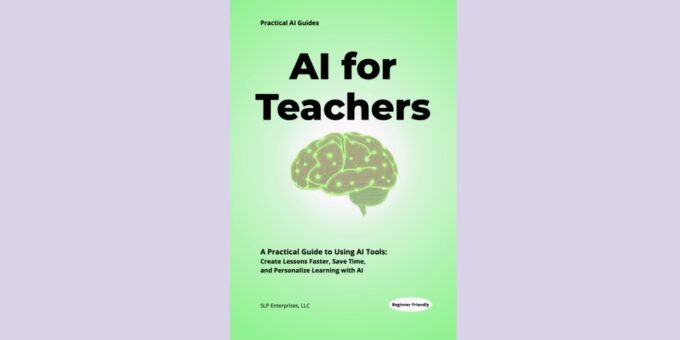
This is exactly why AI for Teachers was written. Rather than adding to the noise of AI hype, this book cuts through it with clear explanations, classroom-ready workflows, and actionable strategies educators can implement immediately—even if they have never used an AI tool. What you are about to discover will fundamentally change how you think about technology, assessment, and your professional role in an AI-shaped future.
A Practical Guide Built for Real Classrooms
AI for Teachers: Practical Strategies, Tools, and Lesson Plans to Save Time, Personalize Learning, and Use Artificial Intelligence in the Classroom is the no-nonsense resource educators have been waiting for. SLP Enterprises, LLC has built its reputation on one guiding principle: simple ideas, practical tools, and real-life results. Every page of this book reflects that commitment. There is no jargon, no overwhelming theory, and no advice that requires a computer science degree to understand.
The book delivers concrete strategies for grading automation that save hours each week without sacrificing the quality or specificity of the feedback students need to grow. You will discover how modular comment banks can replace generic remarks with targeted, actionable guidance that connects to individual student work. You will also find a step-by-step implementation planning framework that takes AI adoption from a single classroom experiment to a department- or district-wide system—with built-in privacy compliance and vendor evaluation checklists at every stage.
What sets this book apart in the crowded field of education technology resources is its unflinching focus on equity, ethics, and human judgment. It does not treat AI as a magic solution. Instead, it presents AI as a powerful but imperfect tool that requires teacher oversight, critical thinking, and a clear ethical framework. Transparent AI use builds student trust, and this book shows you exactly how to communicate AI practices to students and families in language that is honest, accessible, and confidence-inspiring.
Three Insights That Will Change How You Teach With AI
One of the most powerful ideas in AI for Teachers is treating AI as a coach rather than a ghostwriter. Instead of letting students generate finished content with a single prompt, the book guides teachers in designing workflows in which students first create an initial draft, then use AI to ask targeted questions about clarity, tone, and organization. This approach preserves academic integrity, builds genuine writing skills, and makes it much harder to outsource thinking entirely. Portfolios, draft histories, annotated sources, reflective logs, and screencasts become evidence of learning—generating richer formative data than any final-product-only assessment ever could.
The book also tackles one of the most underappreciated risks in AI-assisted classrooms: the danger that high AI confidence can mask inaccurate outputs. As the book makes clear, high confidence does not guarantee accuracy. AI can produce errors that are random, systematic, or outright hallucinations—plausible-sounding information that is simply false. AI for Teachers provides classroom routines to build AI literacy and critical-thinking habits, including fact-checking protocols, source cross-referencing strategies, and structured approaches for flagging surprising outputs before they reach students. Teaching students to verify before they trust is not just a digital literacy skill—it is a life skill.
Perhaps most importantly, the book frames ethical AI use around what it calls an ethic of care: using AI to expand opportunities for all students, not to take shortcuts, and ensuring safeguards are in place so no student is left behind. This means addressing equity and access head-on—including strategies for students without reliable devices or home internet—and establishing clear data privacy practices before any tool is introduced. Before using any AI tool, teachers are guided to verify district approval, review vendor data practices, minimize data collection, and use anonymized identifiers. Treating all student-linked data as sensitive is not optional; it is the foundation of community trust.
Your AI-Ready Classroom Starts Here
The future of education will be shaped by teachers who use AI with confidence, intention, and integrity—not by the tools themselves. AI for Teachers gives you the roadmap to become exactly that kind of educator. Whether you are a classroom teacher looking to reclaim hours lost to routine tasks, an instructional coach building a sustainable professional learning plan for your team, or a school leader designing a scalable AI implementation strategy, this book meets you where you are and moves you forward.
Don’t let uncertainty, overwhelm, or fear of costly mistakes keep your students from the personalized, equitable learning experiences they deserve. Ready to transform your classroom with confidence? Get your copy at AMAZON and start building the AI-ready practice your students need today.
What Our Customers Say
See what educators, instructional coaches, and school leaders are saying about their journey to an AI-ready classroom with ‘AI for Teachers’.

4.8
Unified rating from 150 reviewers
|
“I was terrified of AI until I read this book. This book breaks down complex concepts into language I actually understand. The section on academic integrity was a game-changer; I now have a clear framework for discussing AI with my students that feels fair and forward-thinking, not just punitive. The ready-to-use prompts for lesson planning saved me hours every week.” Dr. Elena R. High School History Teacher |
“As an instructional coach, I work with teachers who feel overwhelmed by new tech. This book is the perfect resource to hand out. The implementation plans and evaluation checklists are incredibly practical. I’ve seen teachers move from anxiety to confidence within weeks of using the strategies outlined in the chapters on differentiating instruction. No fluff, just actionable steps.” Marcus C. Instructional Coach |
“Finally, a guide that doesn’t ignore the ethical implications of AI. The chapters on bias and privacy are essential reading for any school leader. We adopted the ‘AI-supported planning workflows’ recommended in the book, and our department’s lesson quality improved significantly. It strikes the right balance between leveraging technology and maintaining the human touch in education.” Sarah P. Department Chair of STEM |

“This book demystified AI for me. I was skeptical about automating grading, but the author explains how to use it to free up time for actual student interaction rather than replacing the teacher’s role. The templates for creating collaborative projects were brilliant. I deducted one star only because I wish there were even more examples for special education differentiation, but overall, it’s a must-read.” David O. Middle School Math Teacher |
“I bought this for our entire faculty, and it has become the cornerstone of our professional development. The ‘no-nonsense’ approach resonates deeply with our staff. We used the evaluation checklists to audit our current tech usage, and the results were eye-opening. This book provides the roadmap we needed to integrate AI responsibly across our whole school.” Anthony P. Elementary School Principal |
“The writing style is engaging and accessible, making it easy to read during a busy planning period. The prompts included in the book are high-quality and immediately usable. I particularly appreciated the focus on personalizing learning; the strategies for using AI to generate reading materials at different levels have transformed the way I support my struggling readers. Highly recommended for any educator.” James W. Literature Teacher & Author |
Enjoy books, movies, and queer culture?
Join us on Social Media.
Facebook | BlueSky | Instagram | Threads | Printrest
#AIforTeachers #EdTech #ArtificialIntelligenceInEducation #TeacherPD #PersonalizedLearning #StudentDataPrivacy #AcademicIntegrity #EquitableAccess #EthicalAI #ClassroomInnovation









Great content! Keep up the good work!